
HOROWITZ GROUP
The Mechanics Servo Laboratory focuses on the use of Micro Electro Mechanical Systems (MEMS) and advanced control synthesis tools to enhance the performance of computer disk drives and other other mechatronic devices. Some of the currently undergoing projects are listed below.
Algorithms for Robust Performance Control Design
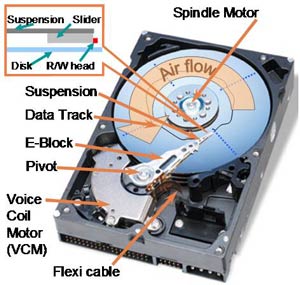
On a hard disk drive (HDD), information is stored on data tracks, which are nominally arranged as a set of concentric circles on the disk. Data is accessed by positioning a magnetic read/write head over the corresponding data track as the disk spins at constant angular velocity. One relevant control problem is the "track following" control problem, in which the position of the read/write head must be maintained over a single data track for an extended period of time. The closed loop position error should be less than 2.3nm to meet the current current goal of the magnetic recording industry (storage density of 4 terabits/in2, with a track width of 23nm).
Several factors make it difficult to achieve the required level of nano-scale performance. These include disturbances present in the system (periodic, non-periodic and measurement noise). Moreover, since there tends to be large variations in HDD dynamics due to variations in manufacture and assembly, the controller must guarantee the desired level of performance for a large set of HDDs. In addition, the angular velocity of the disk during operation and the locations of the servo sectors are fixed and the position error can only be sampled at a fixed, pre-specified rate. This in turn prevents the controller from detecting and controlling high-frequency resonance modes in the HDD.
There are several challenges to designing a controller for a dual-stage multi-sensing HDD. First, since we have multiple sensors and actuators, we must design multi-input multi-output (MIMO) controllers. Second, since the additional sensor signals are sampled at a higher rate than the fixed PES sampling rate, we must control a system which is linear periodically time-varying (LPTV). In particular, this means that frequency domain analysis techniques do not hold. Thus, we are interested in finding fast and reliable methods of designing MIMO controllers for LPTV systems which guarantee a high level of robust performance over all modeled uncertainty. The current approaches to solving this control design problem all use an iteration of convex optimizations to design a controller. Although there are numerical solvers which are guaranteed to quickly find the global optimum for each of these problems, they are prone to numerical problems and tend to require a lot of computation due to the number of variables that are being optimized.
Recently, we have discovered that a number of these optimization problems have special structure which allows them to be solved using Riccati equation solutions (i.e. using eigenvalue decompositions). For instance, one relevant problem is to determine a bound on the worst-case performance of a given closed-loop system. We have shown that an algorithm based on Riccati equation solutions is much faster and more reliably accurate than the mathematically equivalent convex optimization alternative [1]. We have also used Riccati equation solutions to reduce the amount of computation required to design a HDD controller from 4 hours (using the iteration of convex optimizations in [2]) to 16 seconds. Moreover, although both algorithms achieved similar accuracy, the convex optimization approach required multiple attempts to find an initial condition which yielded a high-performance controller whereas the Riccati equation approach worked correctly on the first try.
- Conway, R., and Horowitz, R., 2009. Analysis of discrete-time H2 guaranteed cost performance. In Proceedings of the DSCC 2009.
- Conway, R., and Horowitz, R., 2010. Guaranteed cost control for linear periodically time-varying systems with structured uncertainty and a generalized H2 objective. Mechatronics, 20(1), February, pp. 12-19.
Students : Richard Conway
Integration of piezoelectric sensing and control for nano-scale vibration suppression
Sensing technology remains a limiting factor for tracking position in hard disk drives (HDDs), since dedicated servo sectors on the disk provide the only position information in state-of-the-art commercial drives. We have designed and fabricated novel thin film piezoelectric ZnO sensors directly onto the steel suspension structure that carries the read-write head. Taking an integrated mechatronic approach, we are exploring various control schemes, such as multirate H2 and adaptive filtering, to implement this new sensing technology in an effective manner for vibration suppression and improved tracking. We have successfully assembled and operated dual-stage multi-sensing experimental HDDs that can be used as test beds for future work in our group
- S. Felix, J. Nie, and R. Horowitz, Enhanced vibration suppression in HDDs using instrumented suspensions, accepted to the IEEE Transactions on Magnetics.
- S. Felix, S. Kon, J. Nie, and R. Horowitz, Strain sensing with piezoelectric zinc oxide thin films for vibration suppression in hard disk drives, Proceedings of the Dynamic Systems and Control Conference, Ann Arbor, Michigan, Oct. 2008.
Students : Sarah Felix


Piezoelectric MEMS Microactuator
In recent years, the cost of hard disk drives has continued to decline while track density and storage capacity have rapidly increased. The reduction in track density has led to a need for nanopositioning of the read-write head at frequencies above the conventional servo bandwidth. This presents a challenging set of constraints for low per-unit cost hardware improvement which is most readily met by a second-stage head-based microactuator manufactured through wafer-level fabrication prior to read-write element fabrication.
Research is being conducted with a variety of piezoelectric and electrostrictive materials which can generate the required bandwidth and force without excessive actuation voltages. Various prototype actuators are being fabricated in the Berkeley Microfabrication Laboratory and the Marvell Nanofabrication Laboratory in order to demonstrate the performance benefits of piezoelectric head-based microactuators.
Students : Josiah Wernow
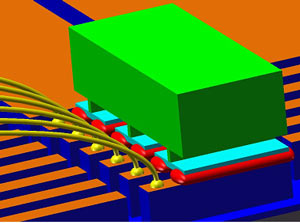 Prototype Piezoelectric Microactuator
Control of dual stage hard disk drives
This project involves control synthesis and implementation for dual-stage hard disk drives. Controllers have been designed for concentric self-servo track writing based on a feedforward control structure. Control algorithms have also been desinged for spiral self-servo track writing under irregular sample rate
- J. Nie and R. Horowitz, 2009, Design and Implementation of Dual-Stage Track-Following Control for Hard Disk Drives Proceedings of the Dynamic Systems and Control Conference, Hollywood, California
- J. Nie and R. Horowitz, 2010, A Tutorial on Control Design of Hard Disk Drive Self-Servo Track Writing, Accepted by 2010 American Control Conference.
Students : Jianbin Nie
 Experimental Setup for the Control Implementation